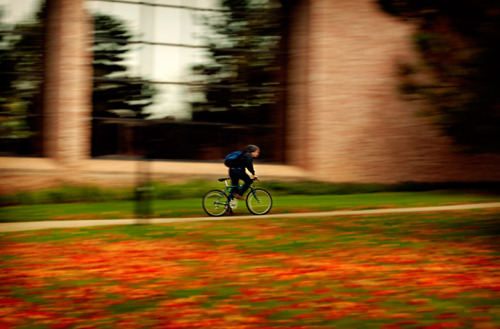
Isn't this photo great? My daughter with hair the color of autumn leaves took it. You can see more of her photography here. |
10/21/10
10 Great Things about Fall


10/18/10
They’re Here!

I'm always very excited when books that I've edited actually become real, live books. And there are two that have just arrived that I really loved working on because they were great books to begin with, and the authors, in both cases, were a true joy to work with.
The first, Meeting Jesus at the Feast, is a publication of Reformed Fellowship, an organization very dear to me because its president is my own Henry. I fell in love with the book the first time I looked at the manuscript. The author, John Sittema, truly is a craftsman with words, and his insights about how the Old Testament feasts are fulfilled in Jesus Christ are often profound. He masterfully shows readers how the "New is in the Old concealed; the Old is in the New revealed" by taking a close look at the Old Testament feasts and showing how the Passover, the Sabbath, and the firstfruits (and the other feasts as well) are fulfilled in Christ and His ministry. If you're looking for a well-written Old Testament study that will enlighten your understanding of Scripture from start to finish, consider Meeting Jesus at the Feast, which you can purchase here.
The second title that I'm privileged to have worked on is Portrait of Paul, by Jeremy Walker and Rob Ventura. Jeremy has now become my favorite UK author to work with, with his clear communication of biblical truth, his great sense of humor, his way with words, and his attention to the details. Here's the publisher's description for the book, which is cleverly written to both pastors and laypeople:
What does a true pastor look like, and what constitutes a faithful ministry? How can we identify the life and labors of one called by God to serve in the church of Jesus Christ? To address these questions, Rob Ventura and Jeremy Walker examine how the apostle Paul describes his pastoral relation to the people of God in Colossians 1:24–2:5. By discussing these essential attitudes, qualities, and characteristics of a faithful minister of Christ, A Portrait of Paul provides gospel ministers an example of what they should be, and demonstrates for churches the kind of pastors they will seek if they desire men after God's own heart.
October is pastor appreciation month, and you still have time to let your pastor know how much you appreciate him. Portrait of Paul would make an excellent gift, and you can purchase it here. And for the next forty-eight hours, you can get this book, regularly priced at $18, for $5.
10/5/10
Mean, Naughty Pharaoh and the Plague of Owies
It's been a while since I spent some quality time with four-year-olds, so when I was asked to substitute teach for the preschool Sunday school class for a few weeks, I wasn't quite sure what to expect. I wasn't even quite sure any more what four-year-olds could do and understand. But I found the four-year-olds to be lots of fun, and Moses has never been more interesting to me than when I was telling his story to them.
The first week was a little disconcerting for the students. It was only the second week of Sunday school for the season, and already they had a different teacher from the one they had had the previous week. So I explained that their teacher had just had a new baby, and she needed to rest up for a few weeks before she came back to be their teacher. We went on with our lesson about Moses and the burning bush, and everything went pretty well. I was trying to explain to them that it was a miraculous thing that the bush never burned up. I picked up a paper and asked them, "What would happen if I lit this paper on fire? What would it look like after it burned for awhile?" Daniel wanted me to demonstrate what it would look like right then and there. I suggested we should just use our imaginations. I also learned in week 1 how quickly class time is over when we got the five-minute warning and we hadn't even started our crafts yet.
Week 2 had the kids asking me when "Mrs. Ybema" would be back. It didn't feel like a great start to the lesson, especially because Mrs. Ybema had been their teacher last year when they were three. I told them that Mrs. Tripp would be back as soon as she had rested up some more from having her baby. While the kids were coloring a picture of some children, Kristina suddenly spoke up and said, "Boys are brownish." She was, in fact, coloring the boy in her picture brown. I said, "Look at Jacob (the lone boy in the class). He isn't brownish." But Kristina insisted, "Boys are brownish." Good to know, Kristina.
Finally, last week, the kids seemed to be comfortable with me. During song time, they turned their little faces to watch me as we sang songs and did the motions, wanting to get it right. Nobody asked when the teacher would be back. In fact, Morgan, who is finally learning that I'm the one who is supposed to talk and she is the one who is supposed to listen, called me teacher. We learned about the first nine plagues that God sent to judge mean, naughty pharaoh (Kristina's apt description—he was mean and naughty). We also decided to change the name of the plague of boils to the plague of owies. And if you're four, a plague of owies is much more terrible than a plague of boils.
So now my time of service is over. Mrs. Tripp has rested up from having her baby and will be taking the class back. And even though I've been with them for only three weeks, I will miss the four-year-olds: Jacob's beautiful brown eyes and blond curls; Morgan's chatter; Emily's answer to every question (God—which, in fact, is the answer, and I hope she never forgets it); Kristina's four-year-old sense of humor; and Grace and Daniel and their cuteness. We've learned a lot of important things about Moses, God's power, and God's love for His people. And that boys are brownish.
9/22/10
An Open Letter
To Fashion Designers, Clothing Buyers, and Any Others Who Are Responsible for the Pathetic Selection of Women's Clothing in Department Stores Today:
I've just wasted three hours of my life in another futile attempt to buy clothes. And you would think that after so many such futile attempts, I would give up—except for one thing. My personal code of ethics—and the law—require me to wear clothes when I'm in public. The only thing that keeps me coming back is this: my desire not to be naked.
So here's a question for those of you who are making, designing, and selling clothes for women: do you have any idea what most women look like, what sizes they are, and what they want to wear? Life has taken its toll. Age, babies, the occasional order of French fries and desserts, and too little time and money to spare to spend it at the gym have left us wanting to dress in more than a piece of thin knit material that becomes translucent when stretched across a body that admittedly weighs 10 to 20 pounds more than it should. And while some of us have just given in and purchased the paper-thin garments you offer, others of us would prefer not to go around looking like one of those Pillbury biscuit cans that has just popped open, with the dough hanging out the edges. And even though we may be a little pudgy, we would still like to look nice and feel attractive. And I would be very happy to buy clothing that would achieve that—if only you would make it.
Another thing—why do you make twenty varieties of the same three styles for years on end? I have enough of the one-piece- that-looks-like-two shirt and vest sets. I'm still wearing the same ones that I bought several years ago when the style became popular, and I don't want any more. It's time to move on. And what's the deal with all of the cardigans again? I'm sick to death of layering—either because everything I buy is cut so low that modesty demands I wear something underneath or simply because the style requires it. And I WILL NOT wear leggings. And most of you out there past the age of 25 shouldn't be wearing them either. Give it up with the leggings!
And while I realize that this is a world gone crazy casual, there are still a few of us out there who are expected to wear something a little nicer than jeans and a hoodie to the office. I'm good with that; in fact, I prefer it. And if you were to pull out some of your old catalogs from a few years ago you would find an article called a skirt. I like wearing those too on occasion. Perhaps you could spend some of the energy directed toward coming up with another pattern for one-piece shirt and vest sets toward revisiting the skirt.
Clothing manufacturing industry, you are a disappointment to me. And yet I need you. And, believe it or not, you need me. Have you ever gone into a store at the close of a season and seen the racks and racks of leftover clothing that is now marked 75 percent off? Think about why that may be for a couple of minutes. While I don't think a government takeover of the fashion industry would solve the problem, something must be done. Soon. My clothes are wearing out.
9/13/10
Ten Things I Want My Kids to Know about Facebook
- Facebook is only a tool. By itself it is neither evil nor good. What you do with it is evil or good.
- Think of Facebook as a room full of people—some of them you don't know at all, some you know a little bit, and some you are very close to, like family and friends. Only say things on Facebook that you would say in that room full of people. For instance, if you walked into that room and started telling everyone how mad you were at someone, you'd get some strange looks at the least. You'd probably get some stares if you shared intimate details about your health or your feelings for someone else in the room as well.
- When you post something on Facebook, whether words or images, ask yourself if what you're putting there will bring shame to Christ, to whom you belong.
- Friends come very cheaply on Facebook. It takes little effort to post a word of sympathy in a time of difficulty or a word of congratulations in good times. Real friends will sit and cry with you when you are sad, and they will hug you and smile when they are happy for you. There are no hugs and tears on Facebook.
- You can't be a real friend to someone on Facebook. Don't ever think that when you've written a note of sadness or encouragement on someone's wall that you've done your part and been a true friend.
- Is what you're looking at on Facebook causing you to sin? Are you envious? Lusting? Angry? Better to pluck out your Facebook account than to sin.
- Are you wasting time to visit Facebook? Are you visiting on an employer's time? Are you spending time on Facebook rather than doing something else you should be doing—like homework, spending time with a friend or family member, reading your Bible and praying?
- Remember that by what you post you can be a stumbling block to others, causing them to sin.
- Many people use Facebook much like a manufacturer of a product uses advertising--to create an identity for a product, and in this case, for themselves. You know about that person only what he or she wants you to know. So these people use Facebook to show you that they are popular, sexy, successful, or have a perfect family life. They create a false identity and find value in the affirmations of others. Don't use Facebook for that. Remember that your identity and value are in Christ, not in what you say about yourself or what others say about you. Don't seek affirmation on Facebook because the responses you get will be shallow and leave you craving more.
- It might not be possible for people to identify you as a Christian by everything you post on Facebook—and that's okay—but don't post something that would cast doubt on the fact that you are a Christian.
Subscribe to:
Posts (Atom)